
I Nuovi Orizzonti del Cancro: Oltre i “Tratti Distintivi” verso un’Organizzazione Sistemica
The New Horizons of Cancer: Beyond the “Hallmarks” Toward a Systemic Organization
Il cancro non è solo un insieme di cellule che crescono senza controllo; è una patologia complessa che coinvolge l’intero organismo. Negli ultimi 25 anni, il concetto di “Hallmarks of Cancer” (i tratti distintivi del cancro), introdotto originariamente da Douglas Hanahan e Robert Weinberg, ha fornito una struttura logica per comprendere questa complessità. Quello che era iniziato come un elenco di sei capacità acquisite si è evoluto in un modello multidimensionale che include interazioni sistemiche e nuove frontiere biologiche.
Cancer is not merely a collection of cells that grow uncontrollably; it is a complex disease involving the entire organism. Over the past 25 years, the concept of the “Hallmarks of Cancer” (the defining traits of cancer), originally introduced by Douglas Hanahan and Robert Weinberg, has provided a logical framework for understanding this complexity. What began as a list of six acquired capabilities has evolved into a multidimensional model that includes systemic interactions and new biological frontiers.
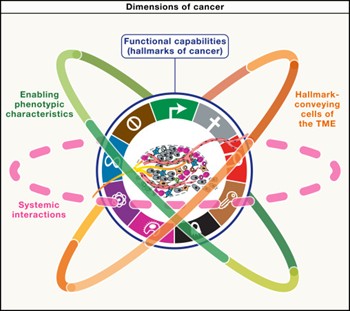
Le Dimensioni del cancro – Questo schema mostra l’integrazione tra hallmarks, aratteristiche abilitanti, microambiente e interazioni sistemiche
The Dimensions of Cancer – This framework shows the integration among hallmarks, enabling characteristics, the microenvironment, and systemic interactions.
Le 9 Capacità Funzionali (Hallmarks)
The 9 Functional Capabilities (Hallmarks)
Queste capacità sono i motori che permettono alle cellule tumorali di sopravvivere, proliferare e diffondersi:
- Sostenere la segnalazione proliferativa: Le cellule tumorali producono segnali di crescita cronici, spesso attraverso mutazioni in oncogeni come KRAS o MYC.
- Inattivare i soppressori della crescita: Vengono aggirati i meccanismi di controllo che normalmente bloccano la divisione cellulare, come i geni TP53 e RB.
- Resistere alla morte cellulare: Il tumore elude l’apoptosi (morte cellulare programmata), spesso sovraesprimendo proteine protettive come BCL-2.
- Raggiungere l’immortalità replicativa: Le cellule riattivano la telomerasi (TERT) per mantenere i loro cromosomi, permettendo divisioni infinite.
- Indurre o accedere alla vascolarizzazione: Per ottenere nutrienti, i tumori stimolano l’angiogenesi (nuovi vasi sanguigni) o “co-optano” i vasi esistenti.
- Attivare invasione e metastasi: Il processo più complesso, che permette alle cellule di viaggiare attraverso il sangue per colonizzare nuovi organi.
- Deregolazione del metabolismo energetico: Il tumore riprogramma il metabolismo (es. glicolisi aerobica) per sostenere una crescita rapida.
- Evasione della distruzione immunitaria: Il cancro impara a nascondersi o a paralizzare le cellule del sistema immunitario (cellule T e NK).
- Sblocco della plasticità fenotipica: Recentemente introdotta, questa capacità permette alle cellule di cambiare “identità” (es. trans-differenziamento), rendendole più resistenti alle terapie.
These capabilities are the engines that allow cancer cells to survive, proliferate, and spread:
- Sustaining proliferative signaling: Cancer cells generate chronic growth signals, often through mutations in oncogenes such as KRAS or MYC.
- Evading growth suppressors: Control mechanisms that normally block cell division are bypassed, such as the TP53 and RB
- Resisting cell death: Tumors evade apoptosis (programmed cell death), often by overexpressing protective proteins such as BCL-2.
- Enabling replicative immortality: Cells reactivate telomerase (TERT) to maintain their chromosomes, allowing endless divisions.
- Inducing or accessing vasculature: To obtain nutrients, tumors stimulate angiogenesis (new blood vessels) or “co-opt” existing vessels.
- Activating invasion and metastasis: The most complex process, enabling cells to travel through the bloodstream and colonize new organs.
- Deregulating cellular energetics: Tumors reprogram metabolism (e.g., aerobic glycolysis) to sustain rapid growth.
- Avoiding immune destruction: Cancer learns to hide from or paralyze immune system cells (T cells and NK cells).
- Unlocking phenotypic plasticity: Recently introduced, this capability allows cells to change “identity” (e.g., trans-differentiation), making them more resistant to therapies.
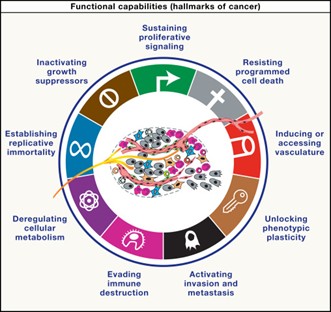
I tratti distintivi del cancro – Rappresentazione circolare delle 9 capacità funzionali acquisite
The hallmarks of cancer – Circular representation of the 9 acquired functional capabilities.
Caratteristiche Abilitanti: Il Terreno Fertile per il Tumore
Enabling Characteristics: The Fertile Ground for Tumor Growth
Oltre ai tratti distintivi, esistono caratteristiche che “abilitano” l’acquisizione di queste capacità:
- Instabilità genomica: Mutazioni, alterazioni cromosomiche ed ecDNA (DNA extracromosomico) accelerano l’evoluzione del tumore.
- Infiammazione favorente il tumore: Il sistema immunitario, nel tentativo di riparare i tessuti, può paradossalmente fornire segnali di crescita al tumore.
- Riprogrammazione epigenetica non mutazionale: Cambiamenti nell’espressione genica che non dipendono da mutazioni del DNA.
- Innervazione: La presenza di nervi nel microambiente tumorale può stimolare la crescita e l’invasione tramite neurotrasmettitori.
- Microbiomi polimorfici: Le comunità di batteri e altri microbi nel corpo possono influenzare drasticamente lo sviluppo del cancro e la risposta ai farmaci.
Beyond the hallmarks, there are characteristics that enable the acquisition of these capabilities:
- Genomic instability: Mutations, chromosomal alterations, and ecDNA (extrachromosomal DNA) accelerate tumor evolution.
- Tumor-promoting inflammation: The immune system, while attempting tissue repair, can paradoxically provide growth signals to the tumor.
- Non-mutational epigenetic reprogramming: Changes in gene expression that do not depend on DNA mutations.
- Innervation: The presence of nerves in the tumor microenvironment can stimulate growth and invasion via neurotransmitters.
- Polymorphic microbiomes: Communities of bacteria and other microbes in the body can dramatically influence cancer development and drug response.
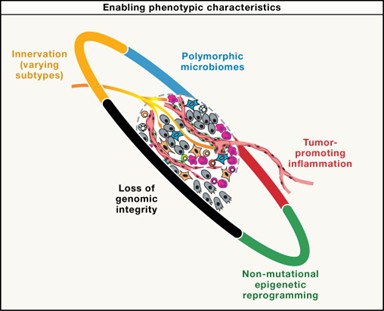
Caratteristiche fenotipiche abilitanti – Illustra fattori come l’innervazione, il microbioma e l’instabilità genomica
Enabling phenotypic characteristics – Illustrates factors such as innervation, the microbiome, and genomic instability.
Il Microambiente Tumorale (TME): Complici del Crimine
The Tumor Microenvironment (TME): Partners in Crime
I tumori sono descritti come “organi fuorilegge” perché reclutano e riprogrammano cellule normali per farsi aiutare:
- Cellule endoteliali e periciti: Costruiscono i vasi sanguigni tumorali, che spesso sono “fragili” e facilitano le metastasi.
- Fibroblasti associati al cancro (CAF): Rimodellano il tessuto e supportano il metabolismo tumorale.
- Macrofagi e Neutrofili (TAM e TAN): Possono essere programmati per sopprimere le risposte immunitarie e favorire l’invasione.
- Cellule senescenti: Sebbene non si dividano più, rilasciano segnali (SASP) che possono promuovere la crescita delle cellule vicine.
Tumors are described as “outlaw organs” because they recruit and reprogram normal cells to assist them:
- Endothelial cells and pericytes: Build tumor blood vessels, which are often “leaky” and facilitate metastasis.
- Cancer-associated fibroblasts (CAFs): Remodel tissue and support tumor metabolism.
- Macrophages and neutrophils (TAMs and TANs): Can be programmed to suppress immune responses and promote invasion.
- Senescent cells: Although they no longer divide, they release signals (SASP) that can promote the growth of neighboring cells.
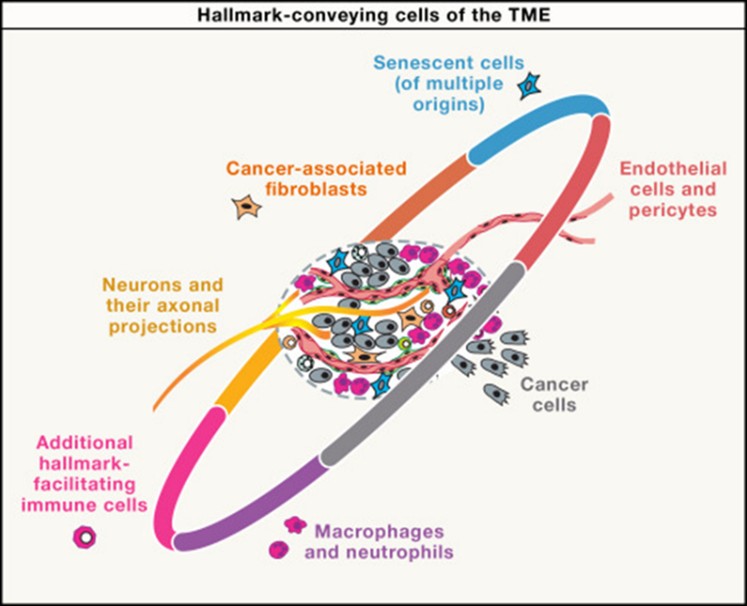
Cellule del TME che trasmettono i tratti distintivi – Mostra la diversità delle cellule non cancerose reclutate dal tumore
TME cells that transmit the hallmarks – Shows the diversity of non-cancerous cells recruited by the tumor.
Fattori Sistemici: Invecchiamento e Obesità
Systemic Factors: Aging and Obesity
Il cancro non agisce in isolamento. L’invecchiamento porta con sé tessuti più “fragili”, infiammazione cronica e un sistema immunitario meno efficiente, creando l’ambiente ideale per il tumore. L’obesità, attraverso squilibri ormonali (come l’eccesso di leptina e la carenza di adiponectina), stimola la proliferazione e l’infiammazione sistemica, aumentando il rischio oncologico.
Cancer does not act in isolation. Aging brings more “fragile” tissues, chronic inflammation, and a less efficient immune system, creating an ideal environment for tumors. Obesity, through hormonal imbalances (such as excess leptin and reduced adiponectin), stimulates proliferation and systemic inflammation, increasing cancer risk.
Il Futuro: Co-Targeting Strategico
The Future: Strategic Co-Targeting
La sfida attuale è la resistenza ai farmaci. Una strategia promettente è il “hallmark co-targeting”: colpire contemporaneamente due o più tratti distintivi.
- Esempio A: Combinare inibitori dell’angiogenesi (VEGF) con l’immunoterapia (ICIs) per normalizzare i vasi e permettere alle cellule T di attaccare il tumore.
- Esempio B: Combinare inibitori di PARP (per l’instabilità genomica) con farmaci anti-angiogenetici.
The current challenge is drug resistance. A promising strategy is “hallmark co-targeting”: simultaneously targeting two or more hallmarks.
- Example A: Combining angiogenesis inhibitors (VEGF) with immunotherapy (ICIs) to normalize blood vessels and allow T cells to attack the tumor.
- Example B: Combining PARP inhibitors (targeting genomic instability) with anti-angiogenic drugs.
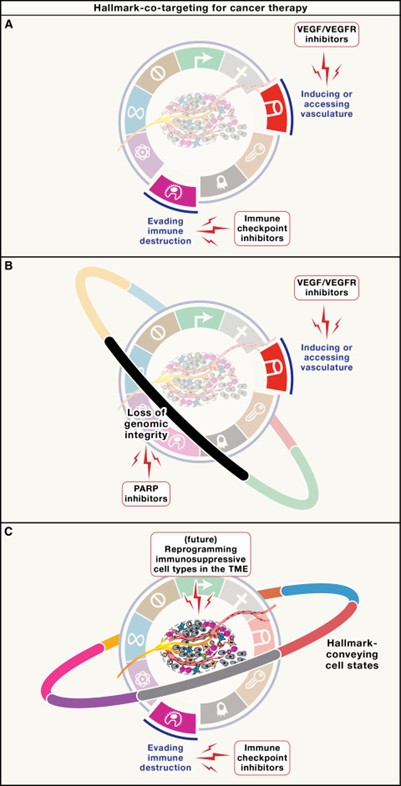
Logica per il co-targeting terapeutico dei tratti distintivi – Schemi A, B e C che mostrano diverse combinazioni di terapie mirate
Logic for therapeutic co-targeting of hallmarks – Schemes A, B, and C showing different combinations of targeted therapies.
In conclusione, comprendere che il cancro opera su più dimensioni — cellulare, microambientale e sistemica — è fondamentale per sviluppare terapie che non solo curino il tumore, ma prevengano anche la sua capacità di adattarsi e resistere.
In conclusion, understanding that cancer operates across multiple dimensions—cellular, microenvironmental, and systemic—is essential for developing therapies that not only treat the tumor but also prevent its ability to adapt and resist.
Author: Stefano Michienzi